
How Diatonic Chords are Everywhere!!
When many students first learn the piano, music can look like a long stream of individual notes to decode one at a time. One of the most powerful things I teach my pupils is how to look past the single notes and see the chords underneath. Once a student understands diatonic chords, the music suddenly starts to make sense. They can see its structure, recognise patterns, and learn pieces with far more confidence.
What are diatonic chords?
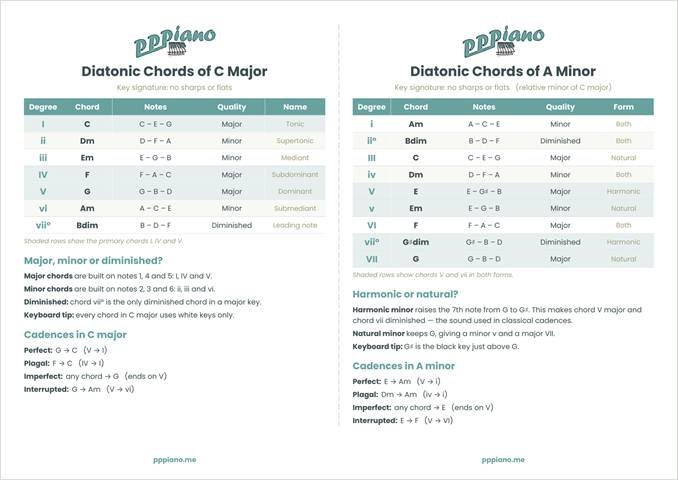
Diatonic chords are the chords built from the notes of a key’s own scale. If you play a scale and build a three-note chord (a triad) on each note, using only notes from that scale, you get the seven diatonic chords of the key.
In C major, they are:
| Chord | I | ii | iii | IV | V | vi | vii° |
| Name | C | Dm | Em | F | G | Am | B dim |
| Quality | major | minor | minor | major | major | minor | dim. |
The pattern of major, minor and diminished chords is the same in every major key. Learn it once, and you can use it everywhere.
Minor keys have their own set. Because the harmonic minor raises the 7th note, chord V becomes major, which gives minor keys their strong pull back to the home chord.
Seeing the structure of music
When students know the diatonic chords, they begin to see that most pieces are built from a small number of familiar building blocks. Chords I, IV and V, the primary chords, appear again and again, from simple beginner pieces to the great classical sonatas.
For example, we have the famous Chopin Fantasy impromptu opens with the tonic chord of C sharp minor to F sharp minor and then to G sharp major the dominant the next progression has the G sharp minor, almost entirely from chords I, IV and V. Look at Beethoven’s Fur Elise in A minor and look for the tonic and dominant chord of E major. Apply this principle to simple melodies like Happy Birthday, Twinkle Litte Star, the Beatles Let it Be and your students will see chord progressions everywhere.
When a student can name these chords, a piece stops being hundreds of separate notes and becomes a clear plan: a few progressions, phrases that rise and fall, and cadences that end each phrase like punctuation in a sentence.
Recognising chord progressions
Once students know what to look for, they start to recognise common progressions everywhere:
- I – IV – V – I: the backbone of countless pieces and songs
- I – vi – IV – V: a favourite in popular music
- V – I: the perfect cadence, the musical “full stop”
- V – vi: the interrupted cadence, a musical surprise
Recognising these patterns builds a deeper musical understanding. It also helps in the aural tests of piano exams, where students are asked to identify cadences and chords by ear.
Memorising music more efficiently
Memorising note by note is slow and fragile: one slip and the whole thing can fall apart. Memorising by chords and patterns is much more secure.
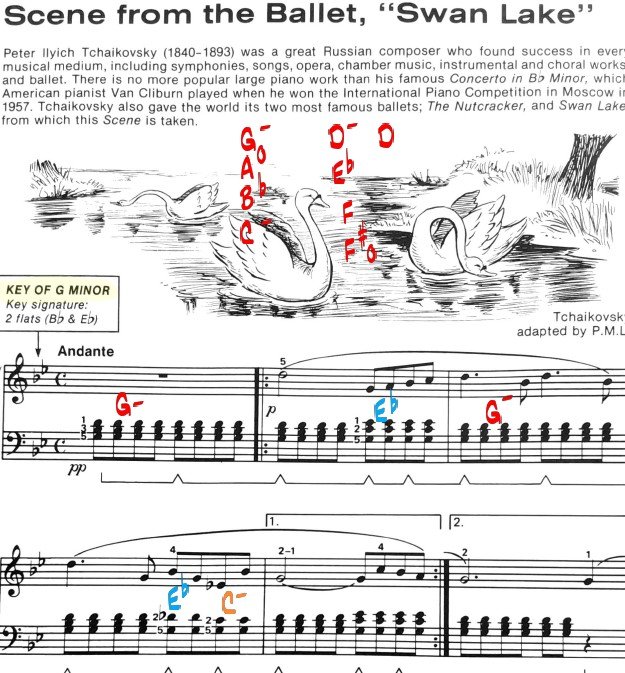
In lessons, I encourage students to make a simple chord map of their piece by writing the chord numbers (I, IV, V…) lightly in pencil above the bars. Instead of remembering sixty separate notes, they remember a short progression such as I – IV – V – I, and their hands fill in the details.
This gives them several kinds of memory working together:
- Harmonic memory: knowing which chord comes next
- Visual memory: seeing the chord shapes on the keyboard
- Aural memory: hearing where the music is going
If a slip happens in a performance, a student who knows the chords can find their place again, because they know where they are in the music.
Better sight-reading
Good sight-readers don’t read every note individually. They read in shapes and patterns. When students know the diatonic chords of a key, they can spot at a glance:
- broken chords and arpeggios in the left hand
- Alberti bass patterns
- chord shapes that repeat
- cadences coming up at the end of phrases
Knowing the key also tells you which chords are most likely to appear. In G major, a student can expect G, C and D chords (I, IV and V). That makes the music more predictable and much less daunting. It’s one reason I connect scales, chords and sight-reading in my lessons: they all support each other.
Using diatonic chords to compose your own music
Diatonic chords are also the perfect starting point for composition. Because they all belong to the same key, they always sound good together. A simple way to begin:
- Choose a key. C major is a great start.
- Write a chord progression, for example I – IV – V – I, one chord per bar.
- Add a melody using notes from each chord, joined by steps.
- End with a cadence: V – I for a finished ending, or finish on V for an open, unfinished feel.
Students are often amazed at how quickly they can create something that sounds like real music, and it deepens their understanding of the pieces they play.
Frequently asked questions
How many diatonic chords are there?
There are seven in each key, one built on each note of the scale.
What are the most important diatonic chords to learn first?
Chords I, IV and V, the primary chords. They appear in almost every piece of music.
When should piano students learn about chords?
They can start very early. Even beginners can learn chords I and V and hear the difference. Understanding grows naturally as students progress through the grades.
Download the diatonic chord charts
To help my students, I’ve created clear one-page Diatonic Chord Charts showing every chord in a major key and its relative minor, side by side, along with the cadences in each key. https://pppiano.me/product-category/pdf-resources/