
How to practice your polyrhythm and get it right
Included in this tutorial
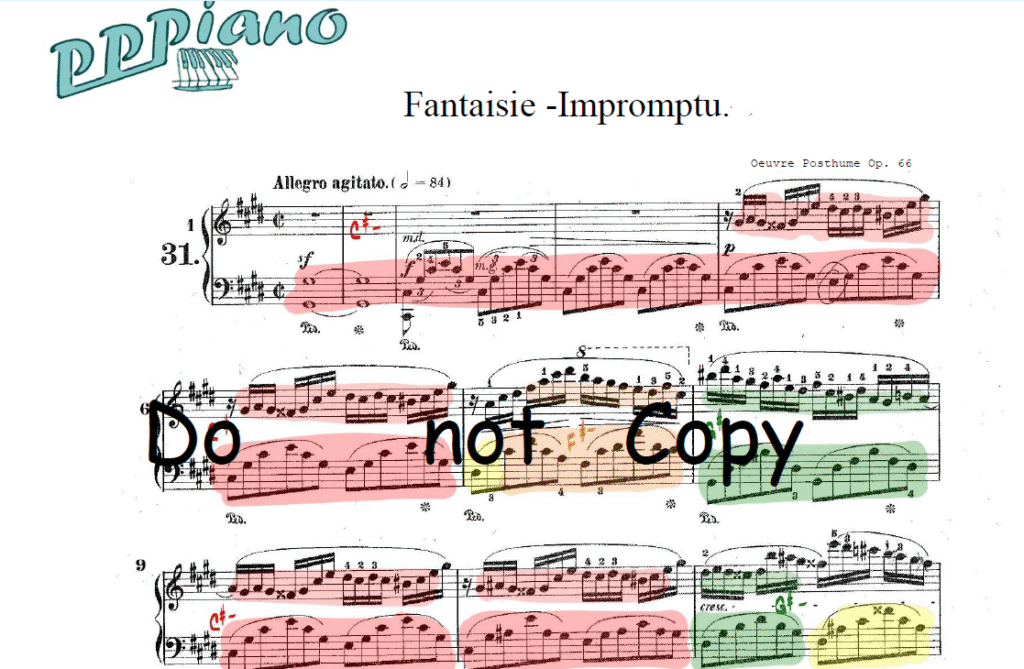
This tutorial offers a unique approach to Chopin’s Fantasy‑Impromptu. Every harmony is carefully color‑coded and annotated, with original lyrics added (Largo section) to guide memory and understanding. Alongside playthrough demonstrations This method makes learning faster, more enjoyable, and helps you retain the piece for the long term.
Videos in this tutorial
1- Introduction + section A1 (bar 1-12)(19 minutes)
2-Section A2(bar13-24)(8minutes)
3- Section A3(bar 25-40)(8minutes)
3b- The chromatic scale and Bar 37 (short)
4- Largo section (bar 41-118)(10minutes) and slow play through
5- Coda section (bar 119-138)(5minutes) and slow play through
6- Shorts on Chords of Db major, Chromatic scale, Polyrhythm practice
7- A slow play through with my coloured sheet music and keyboard showing
PDFs:
Full music score. All harmonies and chords are color-coded to bring clarity and joy to your practice. A quick, accessible way to strengthen memory and deepen understanding
Largo section. Color‑coded sheet music for the Largo section of Chopin’s Fantasy‑Impromptu, plus a separate lyrics PDF. Designed to simplify memorization, highlight musical transitions, and support joyful, confident learning.
Sections: Color‑coded sheet music for Chopin’s Fantasy‑Impromptu, divided into sections for easier study. Designed to improve memorization, highlight musical transitions, and support faster, more confident learning. Section A1 (1-12) Section A2 (13-24) Section A3 (25-40) Largo section (41-118) Coda section (119-138)
Chords: This PDF presents all chords within the scales of C# minor and Db major, color‑coded for easy recognition. A practical guide to strengthen memorization and deepen your understanding of harmonic progressions.
Chopin’s Fantasy‑Impromptu is one of those pieces that seems to live in every pianist’s imagination—stormy, glittering, and irresistibly dramatic. Yet the version we all know today wasn’t actually published during Chopin’s lifetime. In fact, he never wanted it released at all.
So how did it become one of his most famous works?
The answer lies in a remarkable document: the D’Este manuscript.
A Piece Chopin Tried to Hide
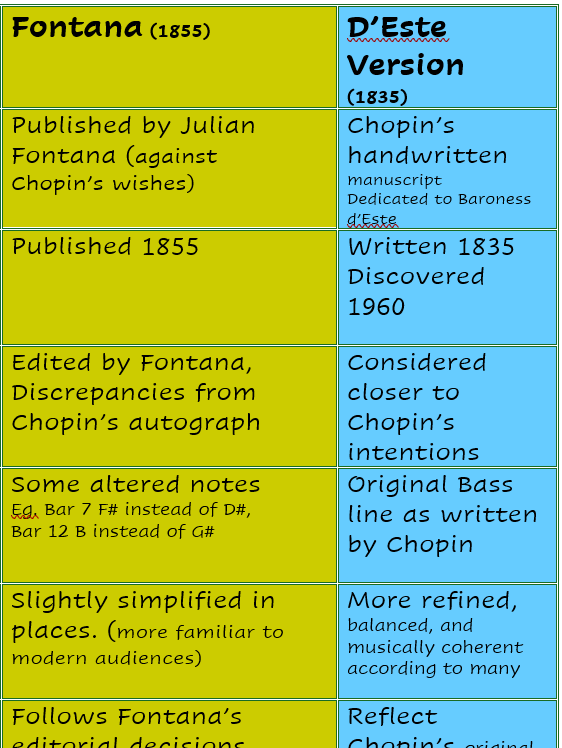
Chopin wrote the Fantaisie‑Impromptu in 1834, but for reasons still debated. After his death, however, his friend and musical executor Julian Fontana ignored that wish and published the piece in 1855.
The version Fontana released is the one pianists grew up with. But it wasn’t the whole story.
The D’Este Discovery
Decades later, a different manuscript surfaced in the possession of the Baroness d’Este. This version, written entirely in Chopin’s own hand, revealed subtle but meaningful differences from Fontana’s edition.
These weren’t dramatic rewrites—they were refinements. But in Chopin, refinements matter.
What Makes the D’Este Manuscript Special?
Musicians often point to three key areas:
- Cleaner harmonic lines
The left hand patterns and inner voices are more transparent, giving the music a lighter, more elegant texture. - More natural phrasing
Chopin’s slurs and articulations shape the musical line with greater nuance than the later printed edition. - A more poetic middle section
The famous lyrical D‑flat major melody is marked with subtle rhythmic and expressive details that soften its character and make it feel more intimate.
These differences don’t rewrite the piece—they reveal its true personality.
Why Pianists Love the D’Este Version
For many performers, the D’Este manuscript feels more “Chopin-like”: less heavy, more refined, and more aligned with the composer’s famously delicate touch. It also offers a glimpse into Chopin’s own priorities—clarity, elegance, and expressive restraint.
Playing the D’Este version can feel like stepping closer to Chopin’s original voice, before editors and publishers added their own fingerprints.
The D’Este manuscript reminds us that even the most iconic works have histories more complex than we imagine.